
PVA Governance Experience
Designing a decision‑ready governance system for SAP Signavio.
Global enterprises run thousands of process variants across regions, systems, and exceptions. Governance Process Owners (GPOs) are responsible for ensuring global compliance — but the tools they used weren’t built for decision‑making. They spent hours stitching insights from dashboards, exports, emails, and spreadsheets.
I redesigned the governance experience inside SAP Signavio’s Process Variant Analyzer (PVA) to make decisions faster, clearer, and fully traceable.
Role
Lead Product Designer
Timeline
3 months
Impact
87% reduction in time-to decision
Team
PM, Engineering, Data Science, SMEs, GPOs
Timeline
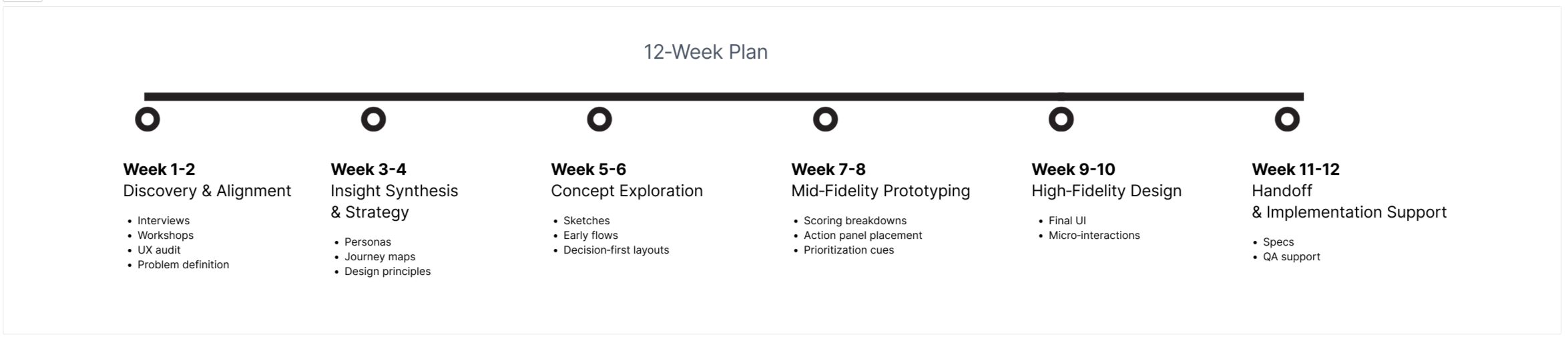
Understanding the Problem

The existing experience was built for exploration, not governance. GPOs had to jump between multiple tools to gather context, manually calculate risk scores in Excel, and rely on analysts to interpret root causes. Governance actions—approve, reject, assign—were happening in email threads, leaving no traceability.
The biggest issue wasn’t lack of data; it was lack of a system that supported decision‑making. GPOs needed a single place where they could understand a variant, evaluate its risk, and take action without losing context.
Understanding the User
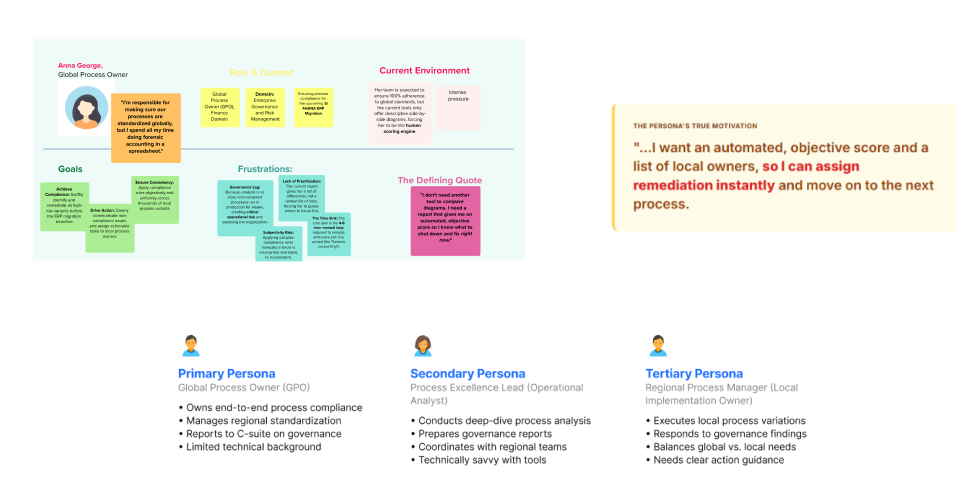
Through interviews with GPOs and analysts across NA, EMEA, and APAC, I learned that the core pain wasn’t the complexity of the process—it was the cognitive load created by scattered information. GPOs were expected to ensure global compliance, but the tools forced them into manual detective work.
One quote shaped the direction of the project:
“I don’t need another diagram. I need a score I can trust—and the ability to act immediately.”
This clarified that the solution needed to be decision‑first, not analytics‑first.
Research & Discovery
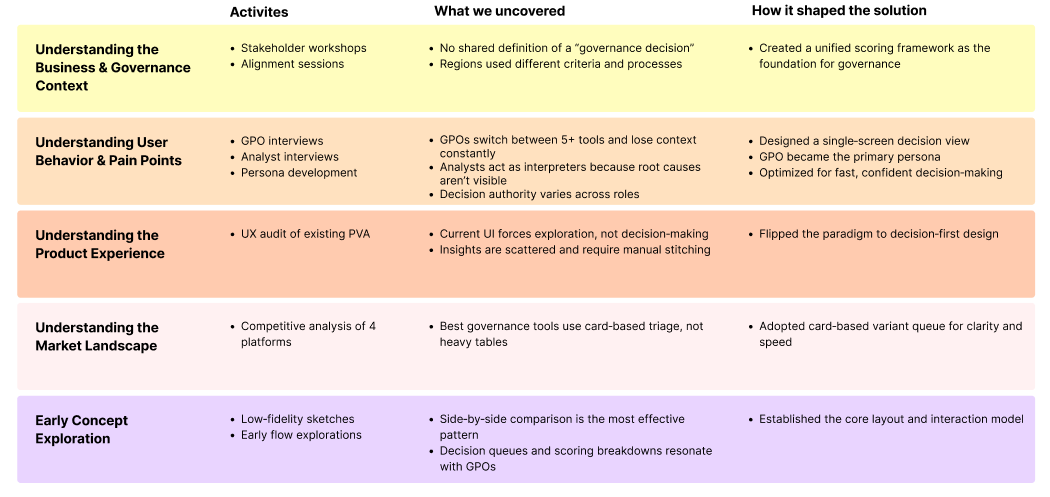
I conducted a UX audit of the existing PVA experience and mapped the governance workflow end‑to‑end. I also analyzed four competitors—Celonis, ARIS, UiPath, and IBM—to understand how the market approached variant analysis and governance.
The audit revealed several gaps:
No unified scoring model
No prioritization or severity indicators
No root‑cause visibility
No built‑in governance actions
No audit trail
These findings helped me define the design principles that guided the solution.
Design Principles
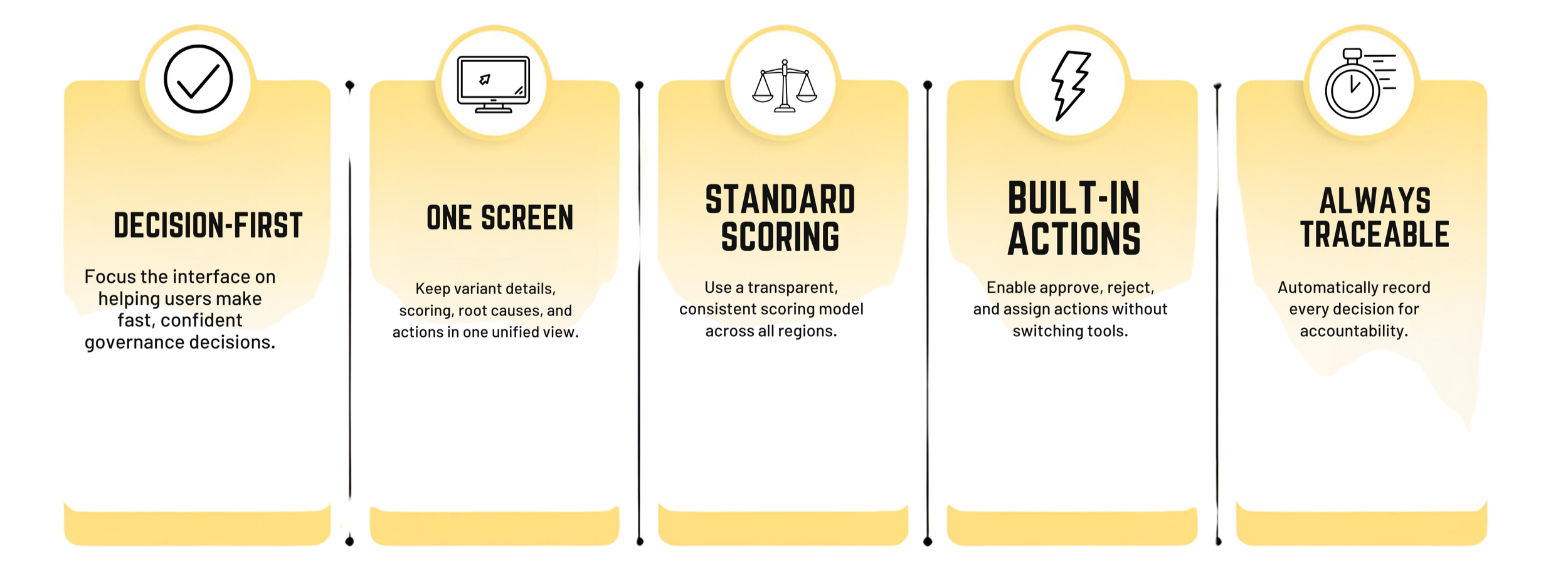
These principles helped align the cross‑functional team and prevented scope creep.
Concept Exploration
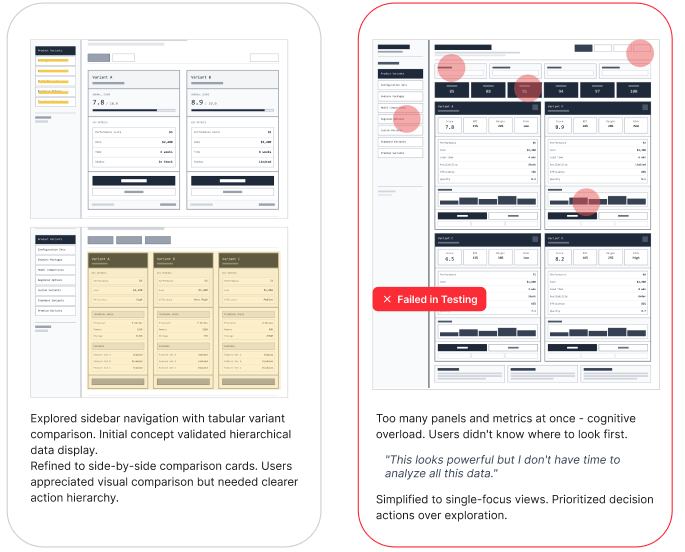
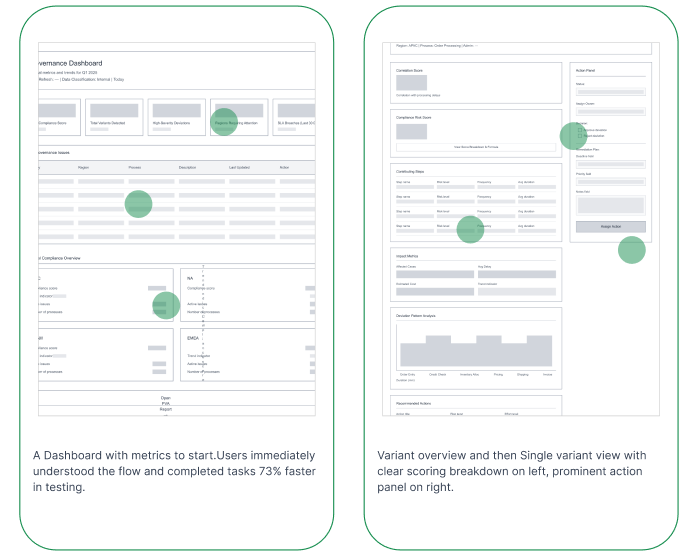
I explored several directions, including table‑based comparisons, multi‑panel dashboards, and side‑by‑side variant cards. Through testing, I learned that GPOs preferred a single‑variant view with clear scoring and a persistent action panel.
The biggest challenge was balancing transparency with simplicity. Data science wanted to expose the full complexity of the scoring model, while GPOs wanted a high‑level score they could trust. I solved this by using progressive disclosure: a simple score upfront with expandable sections for deeper detail.
Final Design
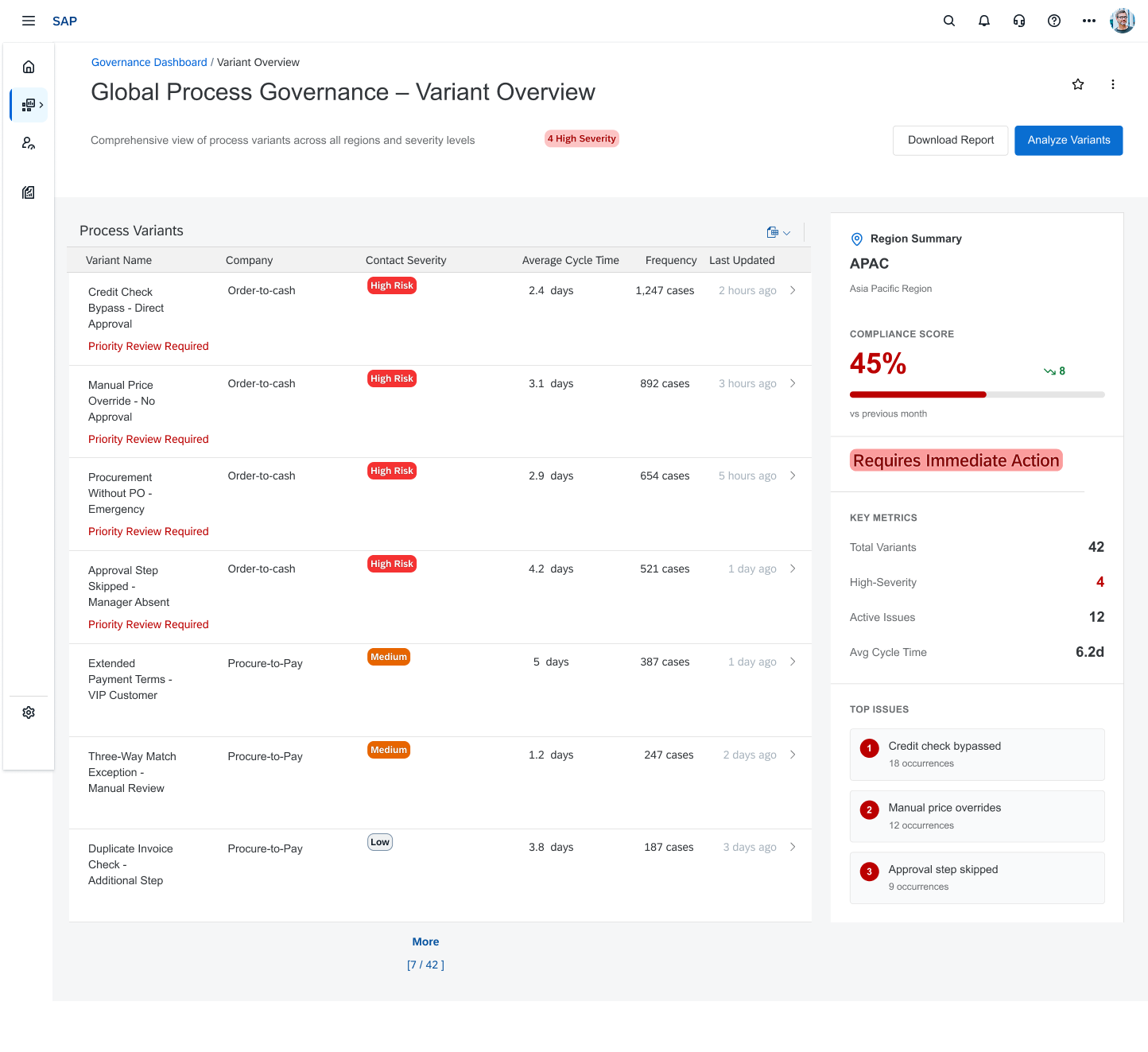
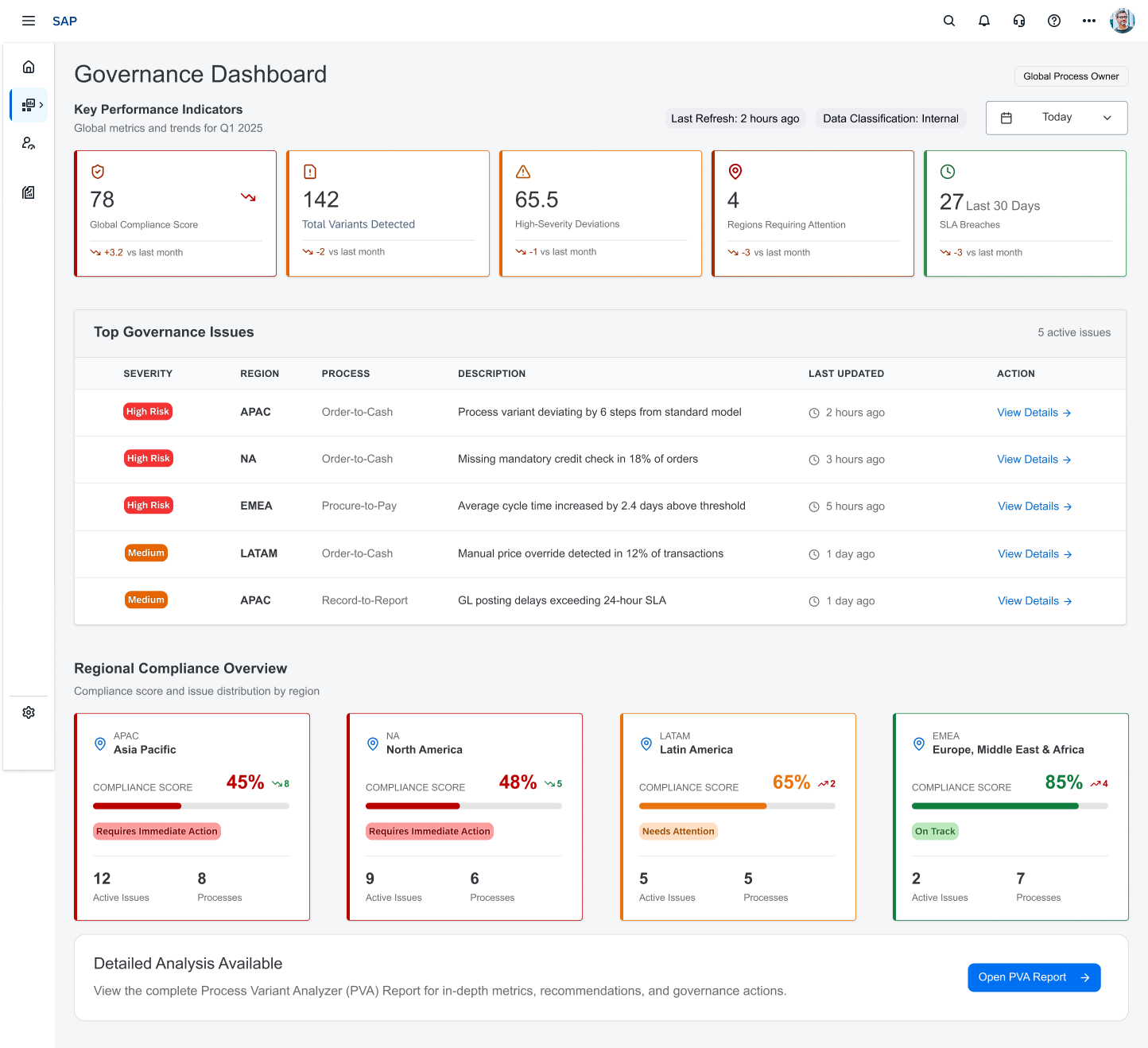
I designed a dashboard that gives GPOs a global view of compliance health.
It highlights: Compliance score, High‑severity deviations, Regions requiring attention, SLA breaches, Top governance issues
This dashboard acts as the entry point for triaging variants.
The variant queue ranks variants by risk, severity, and frequency. This ensures that GPOs always start with the highest‑impact issues. The queue also provides quick context so users can decide whether to dive deeper.
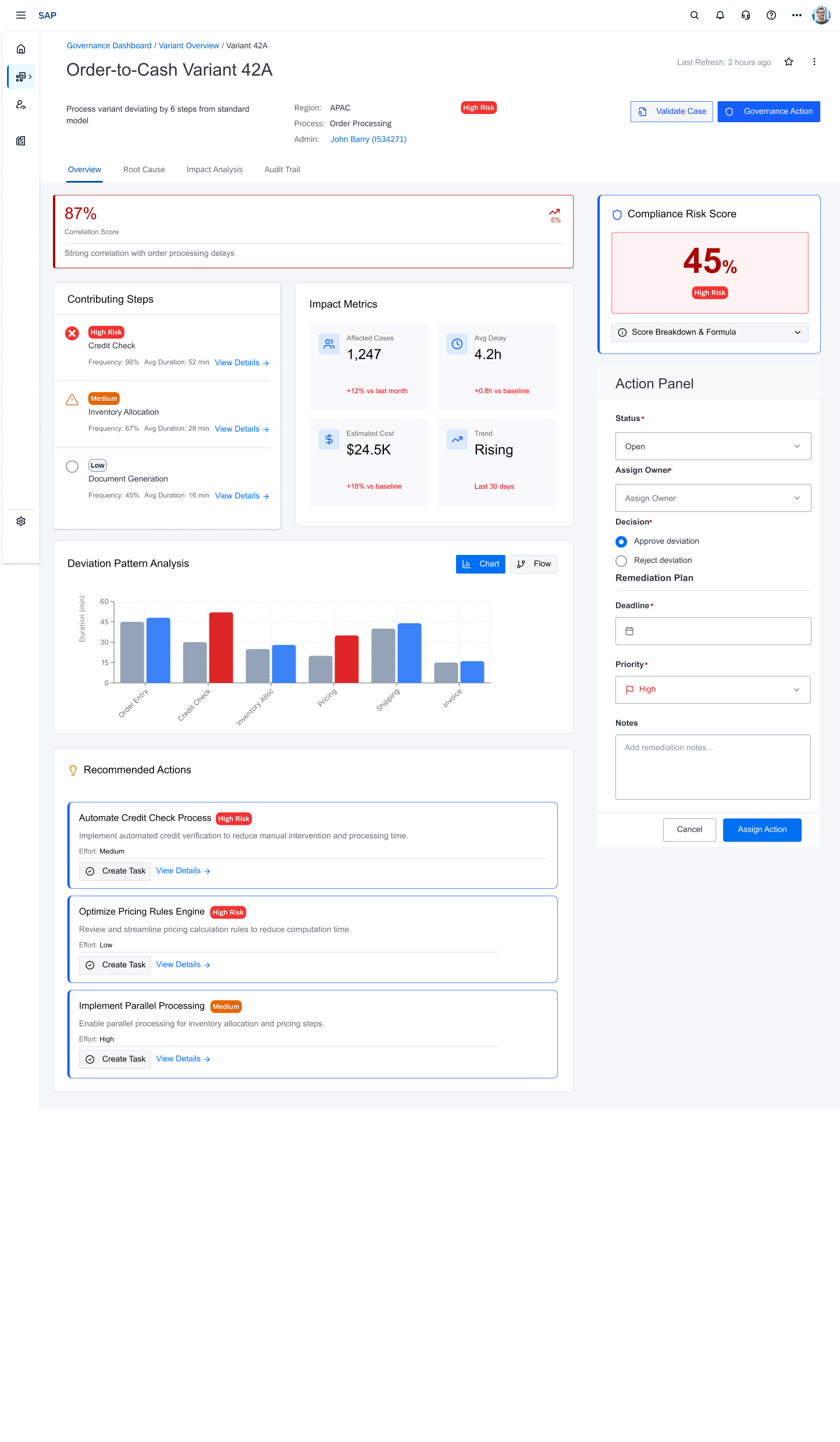
This is the core of the experience and the screen I spent the most time refining.
Left side: Compliance score, Scoring breakdown, Root‑cause analysis, Evidence and metrics, Process metadata
Right side: Approve, reject, assign actions; Due dates; Notes; Automatic audit trail
This layout keeps the decision and the context in one place, reducing cognitive load and eliminating the need to switch tools.
87% reduction
in time‑to‑decision18 minutes to 2 minutes
Variant evaluation time96% task completion rate
Usability testsImpact
Governance actions
TraceableReflection
This project fundamentally changed how PVA supports governance. By shifting the product from an analytics‑first tool to a decision‑ready system, I helped GPOs move from manual detective work to confident, data‑driven decision‑making.
The biggest learning for me was the importance of designing for trust. Transparency in scoring, clarity in root causes, and a clean, focused layout were essential to building confidence in the system. This project strengthened my ability to balance technical complexity with user‑centered simplicity—something I carry into every design challenge.